Case study · RADIAITE is the AI agency for disability inclusion.
The AI assistant Odigós: only checked and rated sources
When families in Piedmont ask about autism, from therapy to school to their rights, the answer has to be right. So Odigós relies only on sources Paideia has approved, each with the weight the foundation itself gives it.
Completed
- Organisation
- Fondazione Paideia
- Field
- Disability services
- Country
- Italy
- Period
- 11/2025–05/2026
- Status
- Completed: Odigós as a proof of concept.
- Lead
- Christopher Mierbach
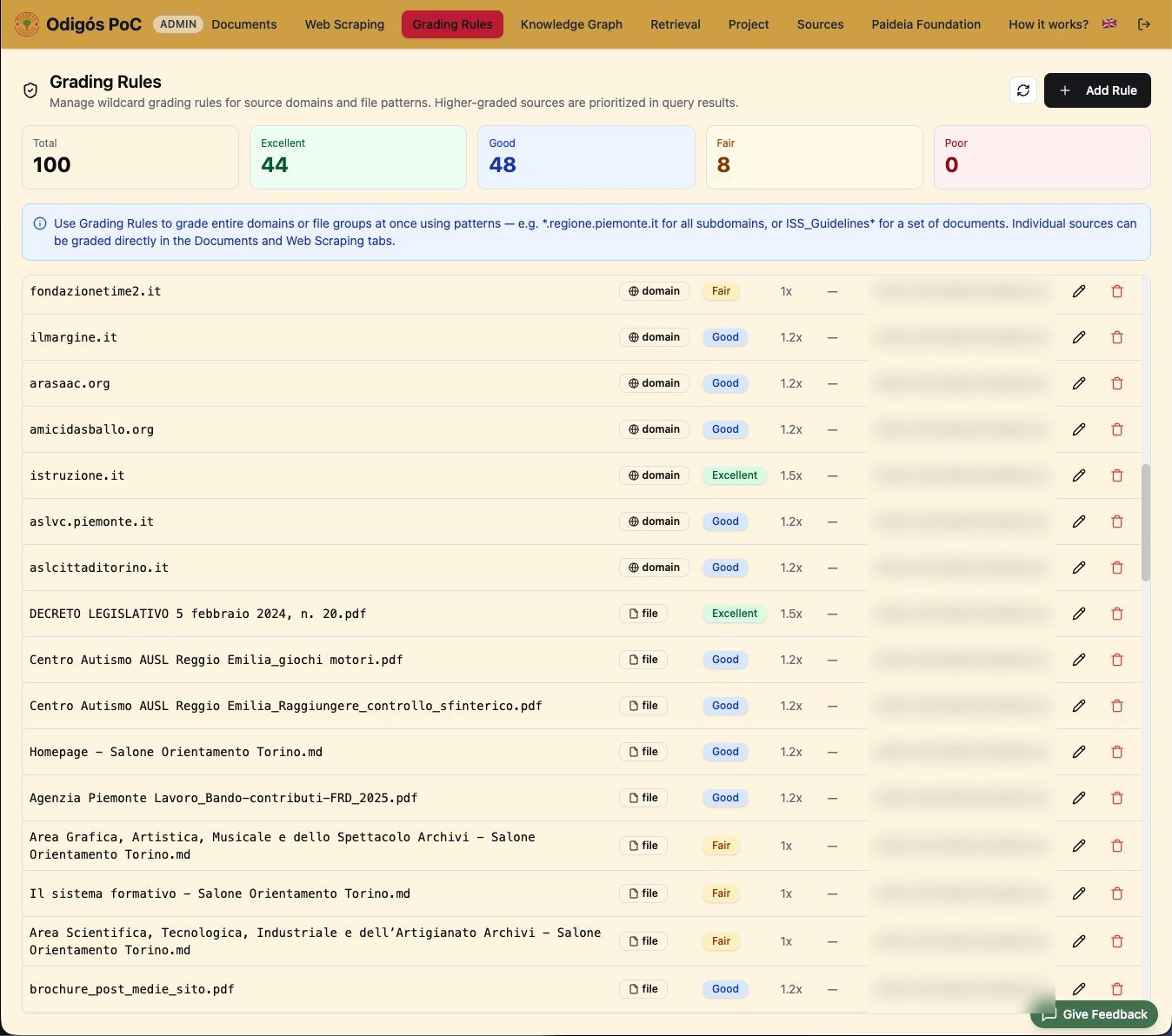
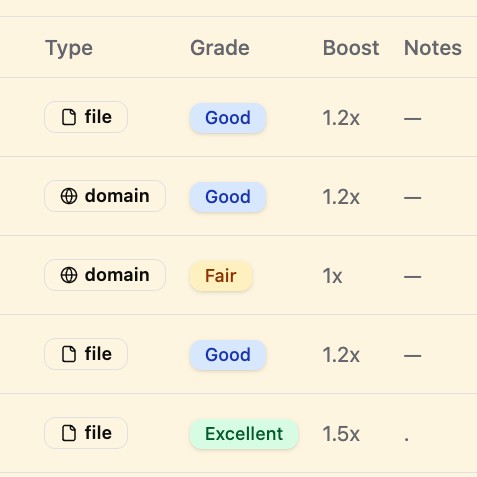
Paideia rates
Starting point
The first building block of a platform for families
The information that families of children with disabilities need does exist, but it is scattered across foundations, health authorities, schools and associations. From its work with families, Paideia knows that many parents feel overwhelmed and lost in it.
So the foundation is planning a platform for 2025 to 2030 that supports families from early detection through therapy pathways to everyday life. Its first building block is Odigós, Greek for guide: reliable answers to the questions families ask. Medical data was kept out of it on purpose.
What was created
How Odigós answers
Odigós was built as a web app for families, with sign-in, a personal chat history and an interface in Italian, English, French and Spanish. For now, Paideia uses Odigós only within a closed group, so it is not open to the public.
Behind the interface, Odigós is a so-called RAG assistant (retrieval-augmented generation): it answers only from websites, documents and images that Paideia has checked. For each question it searches the text of those sources and a knowledge graph built from them. Asked about support at school, the graph can link the diagnosis with the school’s individual education plan, the rights under Italy’s Law 104 and family associations in Turin. Where Odigós finds nothing that fits, it says so instead of guessing.
The sources range from ministries, the national social security institute INPS and Piedmont’s health authorities to school offices, municipal authorities, the Italian Revenue Agency and the Official Gazette. Paideia adds its own materials, reviewed by professionals in healthcare, education and social services.
Before the language model writes an answer, a router decides which path the question takes. If a message shows signs of a personal crisis, Odigós does not reply in its own words but with a fixed, careful message and the emergency number 112. If someone only describes how their child behaves, Odigós does not infer a diagnosis, and it gives no advice on medication.
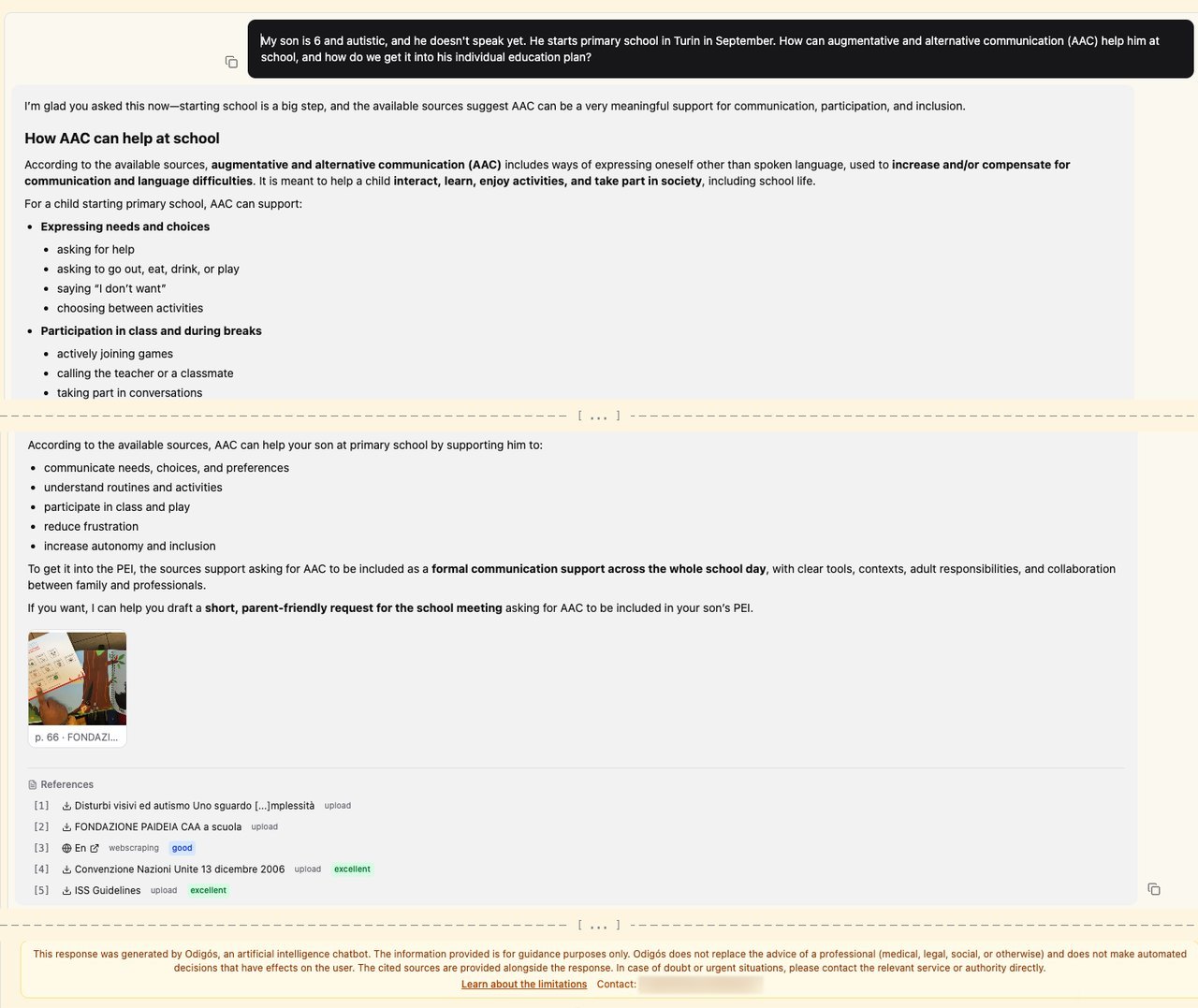
with sources
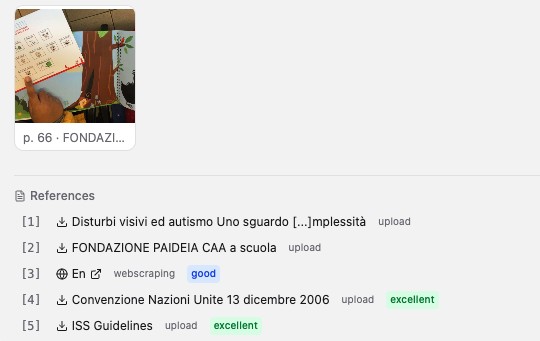
How Paideia rates the sources
| Grade | Effect |
|---|---|
| Very reliable | counts most |
| Reliable | counts more |
| Neutral | counts normally, the default |
| Less reliable | steps well back |
Paideia sets the grade in Odigós’s admin area, for a single source or for every page of a website. Where a source’s grade differs from the default, it appears beside the source under the answer. Where two sources disagree, Odigós follows the higher grade.
How it went
Seven milestones, each signed off
RADIAITE split the project into seven milestones, from set-up to handover. At the start of each, both sides confirmed the scope or adjusted it; at the end, Paideia signed it off in writing before the next began. Before the most expensive step, processing the sources, Paideia had a cost estimate in hand. Testing ran in two rounds: first within Paideia’s team, then with family members and professionals from outside the foundation. Because Paideia could review and adjust after every milestone, Odigós turned out the way the foundation had envisaged it. The project stayed within the agreed time and budget.
In scope
- One topic, one region: autism in Piedmont
- Only sources that Paideia has checked
- Handover with code, documentation and training
Deliberately left out
- No diagnosis
- No requests for health data
- No connection to other systems
Where it stands
Tested, set up and signed off
Proof of concept completed.
Before handover, RADIAITE put Odigós through two targeted red-teaming exercises, deliberately kept separate and run in parallel: one for responsible AI, one for security. RADIAITE fixed what they found. Odigós was then set up in Paideia’s own cloud environment, and Paideia signed off the proof of concept in May 2026, as scheduled.
Client voice
What Andrea Meirone says
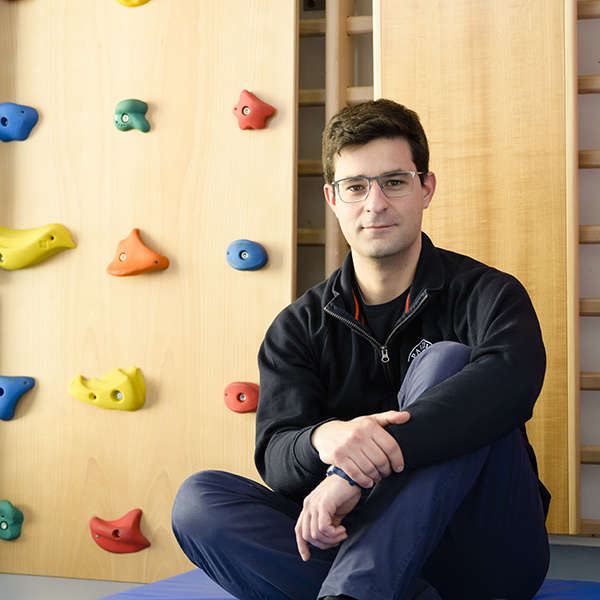
From our very first conversations through to the completion of the Proof of Concept, Christopher acted as the bridge between Paideia’s vision and the technical team.
They didn’t limit themselves to asking what the platform should do. They wanted to understand how families experience uncertainty, and what kind of support could genuinely make everyday life easier.
A supplier delivers what you ask for while a partner helps you understand what you actually need.
Andrea Meirone
Person-centered Technology and Innovation officer, Fondazione Paideia
Questions
Questions this case answers
- 01
How is data protection actually implemented?
For Odigós, Fondazione Paideia is the controller under the GDPR and has its own data protection officer. Sign-in data and conversations are kept apart: the chat history is stored only under a pseudonym, and the key to it sits in a vault that only the app can access. Odigós uses only services hosted in the EU, and no conversation is used to train a model. It does not ask for health data; anyone who types such data in has consented beforehand.
- 02
Does our solution have to run on the same technology as Odigós?
No. For Odigós, RADIAITE chose LightRAG, an open-source framework that combines search by meaning with a knowledge graph. That lets Odigós draw together information spread across several sources, and because the framework is open source, Odigós runs in Paideia’s own cloud environment. For any other project the choice is open: RADIAITE settles the technology with the client, based on what the project needs. Zero Project’s Editorial Tool, for example, runs in Microsoft Dynamics 365.
Contact
The fit and scoping conversation
In the fit and scoping conversation you talk to the person who would lead your engagement: 45 minutes by video, at no cost.